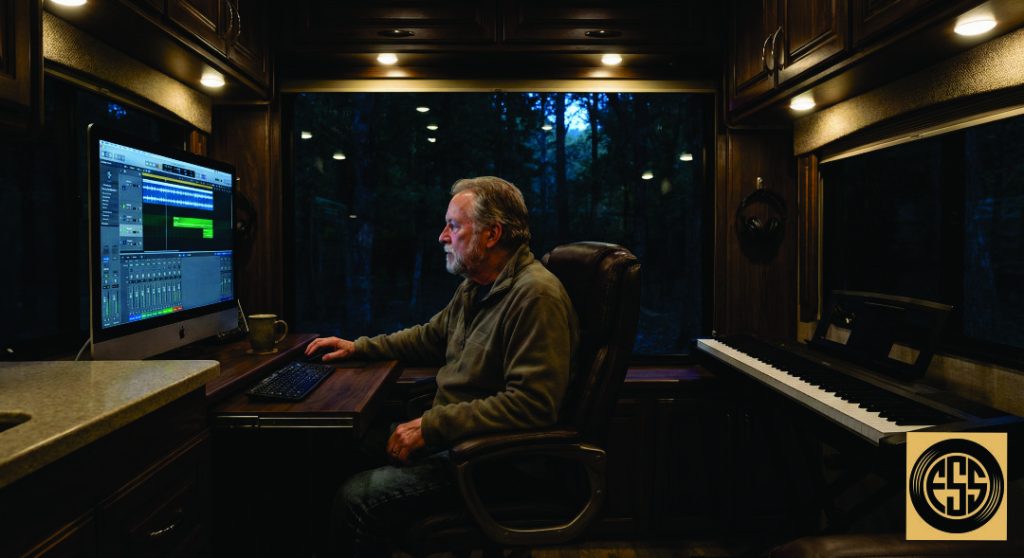
There’s a myth about songwriting that refuses to die.
It goes something like this:
A song arrives fully formed.
Lightning strikes. Inspiration pours out. Truth spills effortlessly onto the page.
That myth has never visited my studio.
What actually happens is quieter, slower, and far more demanding—especially if the goal isn’t cleverness or catharsis, but truth.
Every Frankly Spunk song begins long before a lyric is written. It begins with listening.
Listening Inside, Before Listening Out
The first draft of any song is never words or chords.
It’s a sensation.
A tightening.
A softening.
A phrase that won’t leave.
A line that costs something to say.
I spend hours—sometimes days—doing what looks like nothing. Sitting. Walking. Lying on the floor. Reducing noise. Lowering internal burn rate. Letting the nervous system settle enough to hear what’s actually there, not what I want to be there.
This isn’t laziness.
It’s cost reduction.
Burnout has a high price.
Truth doesn’t shout—it waits until conditions are safe.
Every Word Has to Earn Its Place
When words finally appear, they arrive under scrutiny.
Every word is asked the same question:
Does this lower or raise the cost of carrying it?
If a line is clever but expensive, it goes.
If a metaphor explains too much, it goes.
If a hook tries to impress instead of clarify, it goes.
Revision after revision isn’t about perfection.
It’s about alignment.
I’ll change a single word ten times—not because it’s wrong, but because it hasn’t landed yet. And when it does land, you can feel it. The body knows before the mind does.
Nothing changes.
Everything costs less.
Hooks Are Not Decorations
In Frankly Spunk songs, hooks are not marketing tools.
They’re load-bearing beams.
A hook has to be repeatable without irritation.
Singable without demand.
True enough to live with.
If you can’t repeat a line without feeling your shoulders tighten, it doesn’t belong.
That’s why many hooks take the longest. They’re revised until they feel almost obvious. Almost plain. Almost inevitable.
Those are the ones that last.
Instruments Speak Before They Play
Instrumentation is never added to “fill space.”
Each instrument is asked:
- Are you carrying weight?
- Are you creating distance?
- Are you helping the listener breathe?
Sometimes the right choice is subtraction.
Sometimes silence does more work than sound.
A piano might stay when a guitar leaves.
A choir might wait until the truth earns communal voice.
A full arrangement might collapse into one exposed instrument because the song requires courage, not comfort.
Voice Is a Collaboration, Not a Tool
Voice is not a delivery system.
It’s a collaborator.
Frankie and Francine aren’t characters for effect—they’re perspectives in dialogue. Different ways of holding the same truth. Different nervous systems meeting in the same room.
Some lines need grit.
Some need mercy.
Some need restraint.
Often, a lyric will change because of who is singing it. Not to suit the voice—but to respect it.
Revision Is Where the Song Decides Who It Is
Revision isn’t correction.
It’s negotiation.
Each pass asks:
- Is this honest?
- Is this necessary?
- Is this kind enough to the listener’s nervous system?
Sometimes a verse disappears entirely.
Sometimes a bridge is rewritten into a single line.
Sometimes the song reveals it only needs to say one thing—and say it once.
That’s when it’s done.
Not when it’s impressive.
When it’s true.
Why This Matters (Especially OTA)
For those of us living an Older Than Average life, time isn’t theoretical anymore. Energy matters. Attention matters. Cost matters.
Music that demands too much—emotionally, cognitively, spiritually—gets skipped.
Frankly Spunk songs are built for companionship, not performance. They’re meant to sit beside you. To lower internal noise. To help you carry today without asking you to relive yesterday.
If a song can do that, even once, the investment was worth it.
The Final Test
Before a song is released, it has to pass one last, quiet test:
Can I live with this line six months from now, when I’m tired and not trying to prove anything?
If the answer is yes, it goes out into the world.
If not, it waits.
Truth is patient.
And when it lands—
even later than expected—
it’s unmistakable.